There once stood a vast and thriving forest, rich with life and diversity. Towering trees stretched toward the sky, rivers flowed through fertile valleys, and every creature had a place within the natural order. Birds built their nests high among the branches, rabbits and foxes dug tunnels beneath the earth, and larger animals such as elephants and giraffes relied on their strength and size for protection. Though each species faced its own challenges, the forest provided a system that allowed all life to coexist and flourish.
The forest was more than a collection of trees and animals. It was a living framework of order. Every creature, whether predator or prey, understood its environment and knew where to find shelter, food, and safety. The balance was not perfect, but it was stable.
Then, disaster struck.
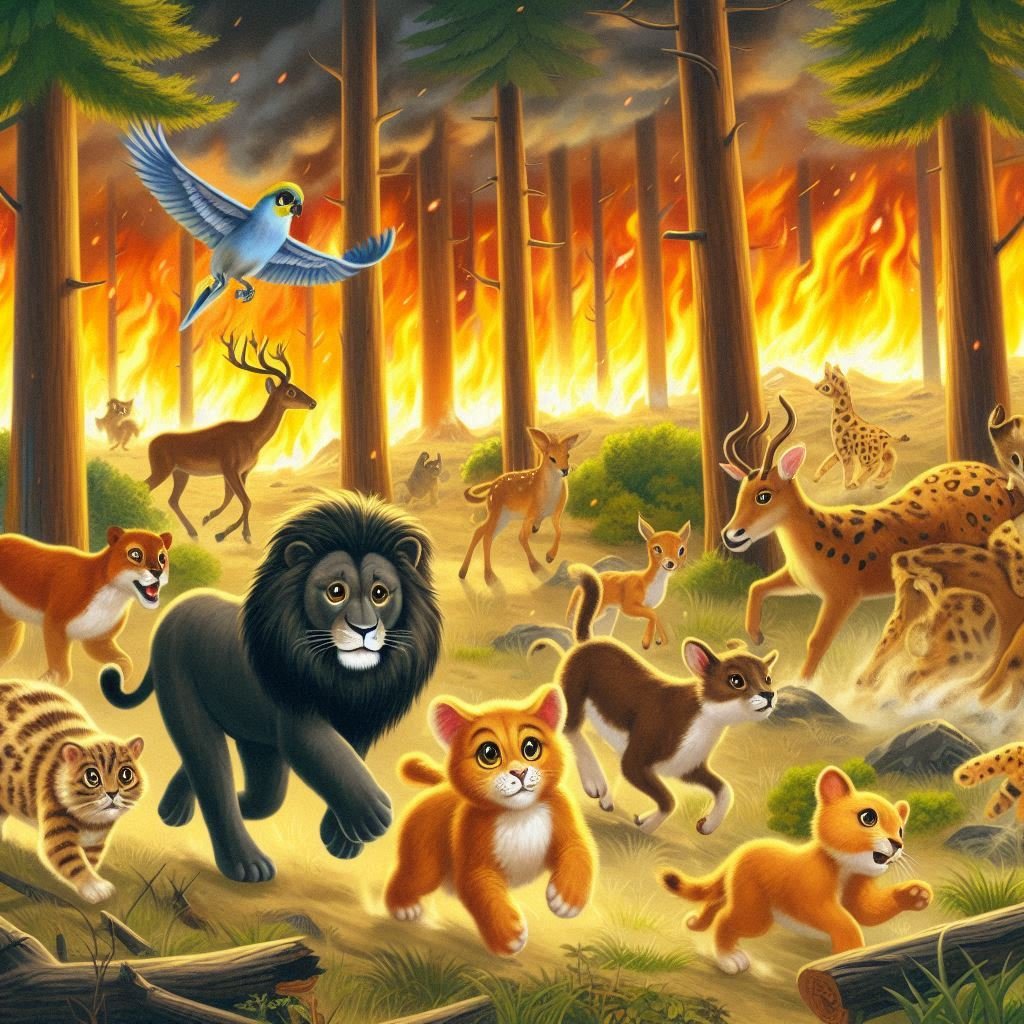
One scorching afternoon, a small spark ignited a fire deep within the woods. What began as a minor blaze quickly grew into an unstoppable inferno. Driven by strong winds, flames raced through the forest, consuming everything in their path. Trees that had stood for centuries collapsed into ash. Thick vegetation disappeared within hours. Panic spread among the animals as their world burned around them.
Faced with a common threat, the animals did something extraordinary.
Natural enemies put aside their differences and worked together for survival. Lions used their strength to clear blocked paths. Elephants formed lines to carry water from nearby rivers and streams. Birds soared above the smoke, helping guide lost animals toward safer ground. Zebras, antelope, and giraffes led herds away from approaching flames. In those desperate moments, survival mattered more than rivalry.
For a brief time, unity triumphed over division.
Days later, a powerful rainstorm finally extinguished the fire. The animals rejoiced, believing the worst was over. But when they returned to their homeland, they discovered a tragedy even greater than the fire itself.
The forest was gone.
The giant trees were reduced to blackened stumps. The bushes and tall grass that once concealed vulnerable animals had vanished. Burrows were destroyed. Nests had disappeared. Rivers were clogged with debris and ash. The natural order that had protected generations was no more.
The animals soon learned that surviving the fire was only the beginning of their struggle.
Food became scarce. Water became difficult to find. Hunger and fear replaced cooperation. The friendships formed during the crisis quickly faded as survival instincts returned. Without trees, prey had nowhere to hide. Without vegetation, shelter was impossible to find. Predators hunted more easily than ever before, and competition for resources became fierce.
The forest that once symbolized life, security, and balance had become a battlefield.
The animals gradually realized that they had lost more than their homes. They had lost the very system that made life possible. Imperfect as it may have been, the forest had provided structure, protection, and predictability. Without it, chaos filled the void.
The Lesson
This story is not really about animals.
It is about society.
The forest represents government, institutions, laws, and the systems that organize human life. Like the forest, governments are rarely perfect. They may suffer from corruption, inefficiency, injustice, or poor leadership. Citizens may criticize them, demand reforms, and seek better governance.
Yet even a flawed government provides something essential: order.
When government collapses entirely, laws lose their meaning, institutions disappear, and security becomes uncertain. People begin relying on tribe, clan, wealth, weapons, or personal power for protection. The strongest prosper, while the weakest suffer. What replaces imperfect order is often not freedom, but instability.
History repeatedly demonstrates that rebuilding a flawed government is far easier than rebuilding a society after complete state collapse.
A bad government can be reformed.
A corrupt system can be improved.
A weak institution can be strengthened.
But in the absence of any governing structure, chaos often becomes the rule, and survival becomes the primary concern.
Conclusion
The burning forest teaches a timeless lesson: people do not truly appreciate the value of order until it disappears.
Just as the animals discovered after the fire, the destruction of an imperfect system can create conditions far worse than the problems that existed before. The answer to bad governance is not necessarily the absence of governance, but the pursuit of better governance.
Whether in a forest or a nation, peace, security, and prosperity depend upon the existence of rules, institutions, and a system that protects the common good.
An imperfect government may frustrate its people, but no government at all can destroy a society.